
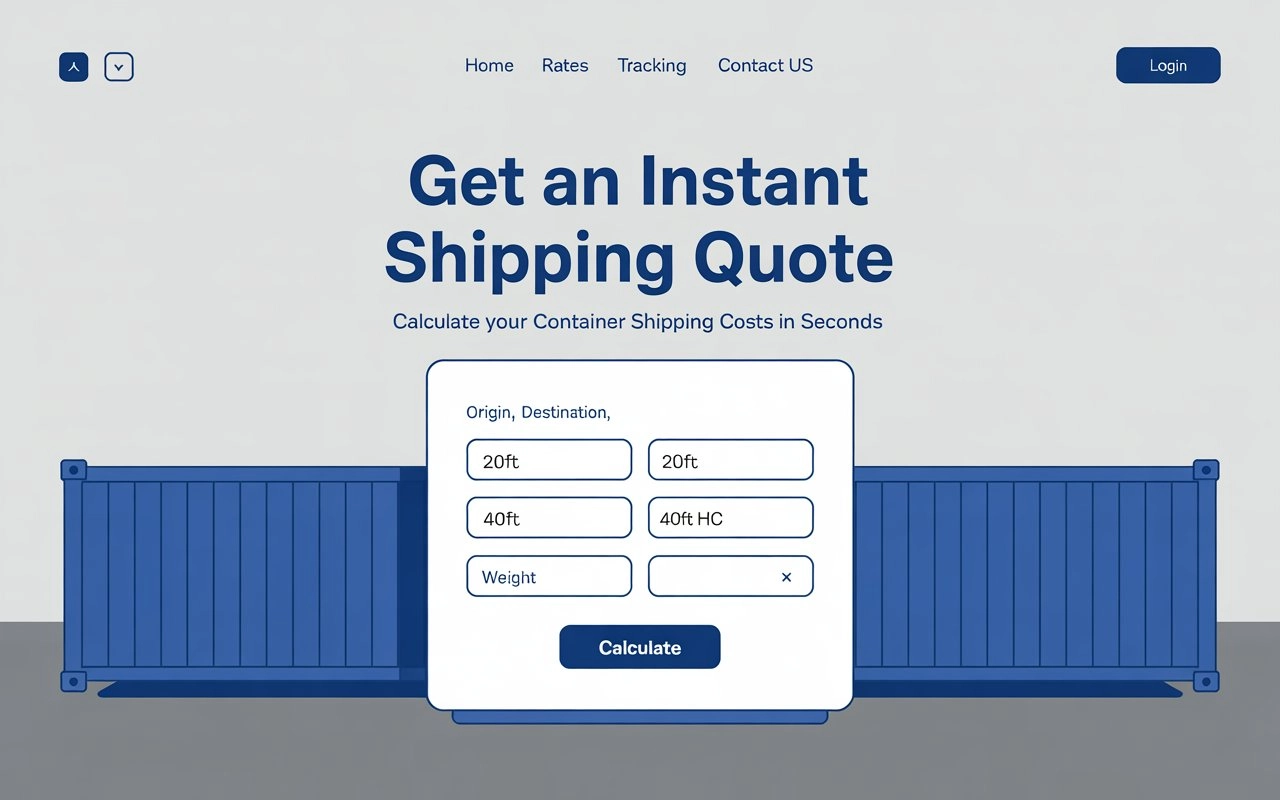
Choose between 20ft and 40ft containers by checking cargo fit and total payable cost. A larger container does not automatically cost twice as much, and a shipment that fits by volume can still exceed a weight or loading limit.
Start with a packed-cargo list
For each item or pallet, record packed length, width, height, weight and quantity. Multiply dimensions in metres to get cubic metres, then multiply by quantity. A crate measuring 1.2 × 1.0 × 1.0 metres uses 1.2 m³ before allowing for gaps and securing. Ten such crates total 12 m³ arithmetically; that alone does not prove a workable loading plan.
Flag anything that cannot be stacked, rotated or exposed to another item’s weight. Door clearance, forklift access, weight distribution and lashing can be decisive even when total volume looks comfortable.
Compare the exact equipment offered
- Ask the carrier for internal dimensions and door opening dimensions for the equipment being quoted.
- Check maximum payload, gross weight and any road or route limits.
- Confirm whether the offer is standard height or high cube.
- Confirm access at both collection and delivery sites and who loads or unloads.
- Request a loading plan when cargo shape, fragility or weight makes fit uncertain.
Nominal container length is not an internal clearance specification. Equipment and route restrictions should come from the actual provider.
Compare complete quotes
Suppose a hypothetical 20ft option costs 2,800 all-in and a 40ft option costs 3,700 on the same route and dates. The larger option is 900 more, or about 32.1%, not 100% more. If one 20ft unit fits the cargo safely, the larger unit may add cost without value. If two smaller units would otherwise be needed, compare their combined handling and transport charges with one larger unit.
Enter each complete option in the container shipping calculator. Save the results and compare equal service boundaries. Prices in this example are invented to demonstrate the decision, not current rates.
When to request an LCL quote too
If you do not need exclusive use of a container, ask for a consolidated LCL quote with all origin and destination fees. Do not assume a universal volume at which FCL becomes cheaper: your route, cargo and quoted handling charges decide the comparison.
Maersk describes how LCL consolidation works. For the full cost worksheet, see estimating container shipping from a written quote.
Content reviewed on 9 October 2026. Worked examples are hypothetical. The original article URL is retained.